
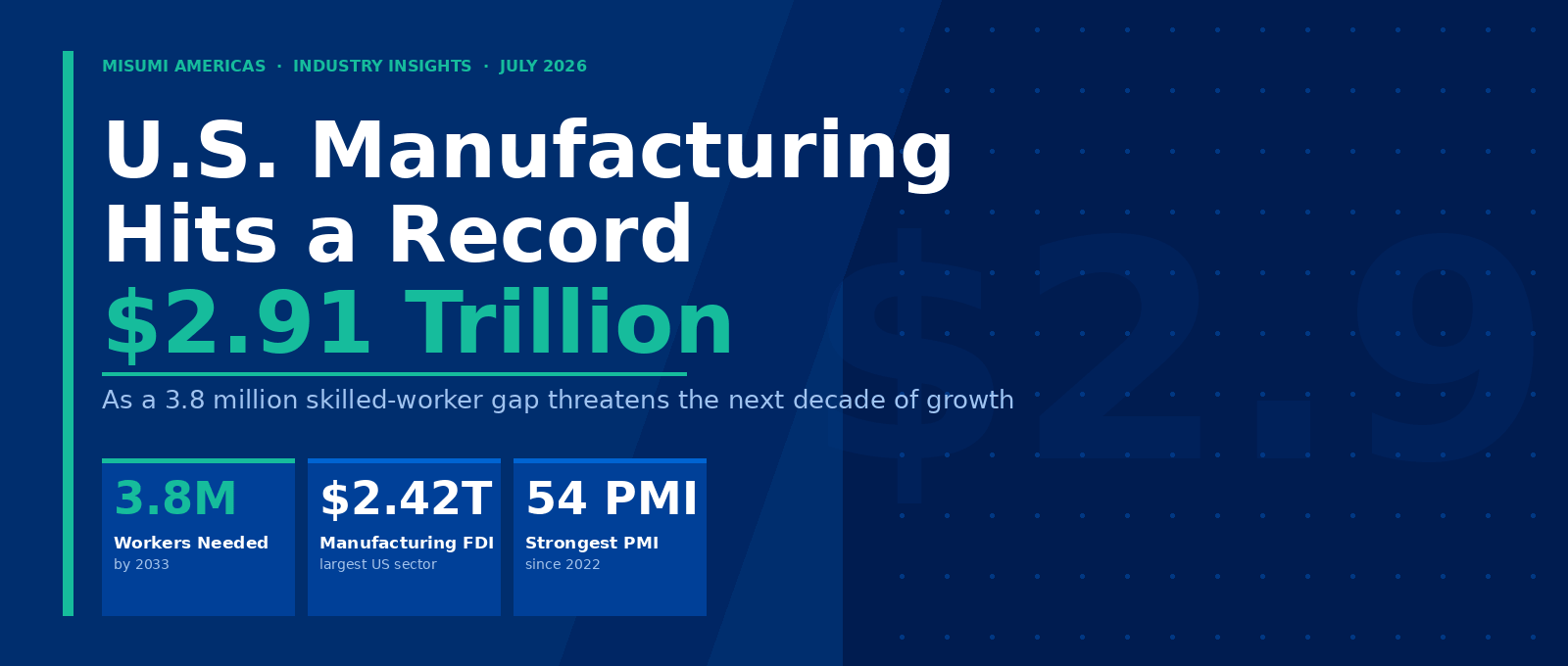
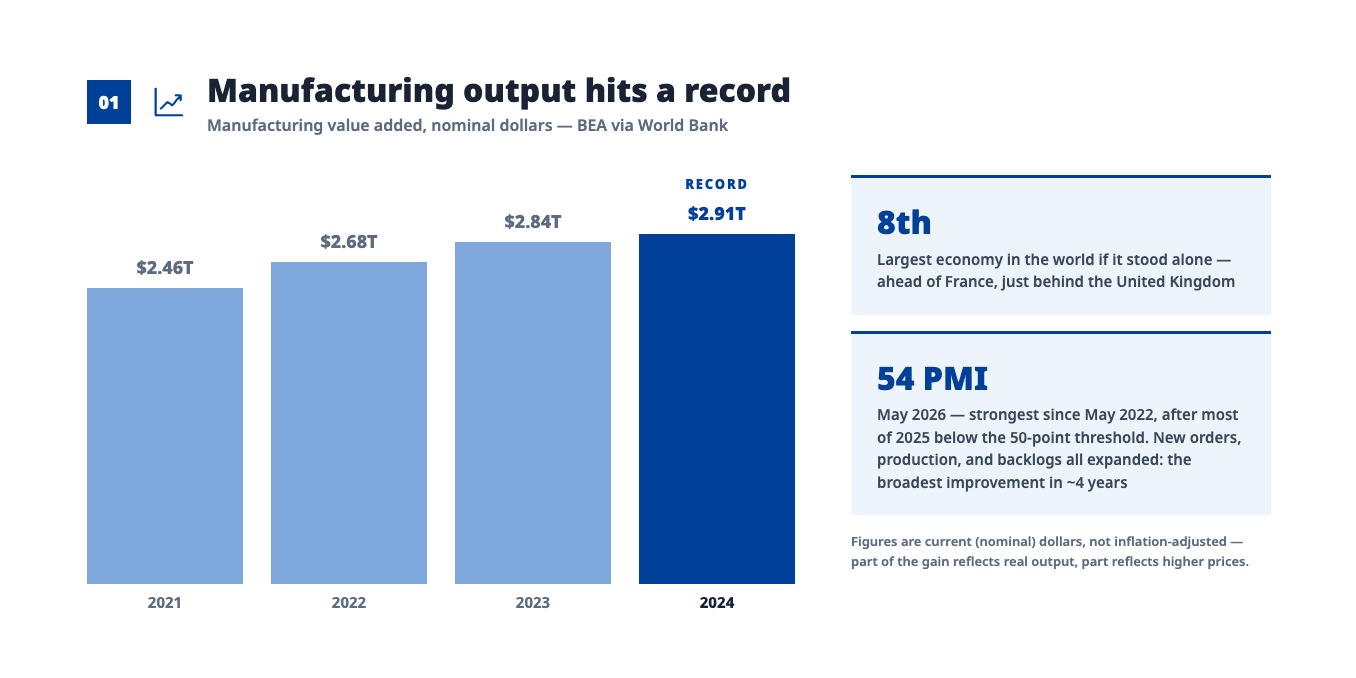
American manufacturing just put up its best numbers in history. Output hit a record $2.91 trillion in 2024. Factory construction spending nearly tripled between 2021 and 2024, peaking at $235.6 billion. Foreign companies have committed $2.42 trillion to U.S. manufacturing—more than to any other sector in the country. And as of May 2026, the ISM Manufacturing PMI hit 54, its strongest reading since 2022, with new orders, production, and order backlogs all expanding together.
Today, MISUMI Americas released The Rise of U.S. Manufacturing, a data report drawing on BLS, BEA, Census, NIST, ASEE, and Reshoring Initiative sources that puts the full picture in one place. We’re sharing it here because the story it tells matters to every engineer and manufacturer reading this.
The workforce picture
There’s a constraint shadowing all that growth. The Manufacturing Institute and Deloitte project the industry will need 3.8 million additional workers by 2033, with about 1.9 million of those positions at risk of going unfilled. Roughly 2.8 million of the 3.8 million gap comes from replacing retiring workers rather than from expansion—it’s a replacement problem as much as a growth problem. As of August 2025, there were 409,000 open manufacturing positions, and more than 65% of manufacturers cite talent attraction and retention as their top business challenge.
There is reason for optimism
The signal from students is encouraging. Enrollment at high-vocational community colleges is up nearly 20% since Spring 2020. Undergraduate certificate programs have grown for four consecutive years. Faster, skills-focused pathways into manufacturing are gaining traction—people are choosing them.
The pipeline is moving in the right direction. It needs to move faster, and it needs to reach deeper into advanced skills that take years to develop domestically but already exist at scale in Japan, Germany, and South Korea. Those three countries are, not coincidentally, the largest sources of foreign investment in U.S. manufacturing. They’ve also spent decades building world-class manufacturing training infrastructure.
That’s the specific gap H.R. 9097, the American Manufacturing Revitalization Exchange Program Act, is designed to close. The bipartisan bill, introduced by Rep. Bill Huizenga and backed by the National Association of Manufacturers, the Manufacturing Institute, United Steelworkers, and others, would place American workers and students in allied nations for 6–12 months of hands-on training in sectors including semiconductors, robotics, and automotive, with a full stipend and industry-recognized credentials on completion.
What this means for the people building things
Record output is a headline. The facilities going up right now are permanent infrastructure—they’ll need to be staffed, operated, and optimized for decades. The engineers and technicians who can run advanced manufacturing processes at full capacity are the constraint on how much of this boom translates into lasting industrial capacity.
Read the full report at misumi.com/rise-of-us-manufacturing.