
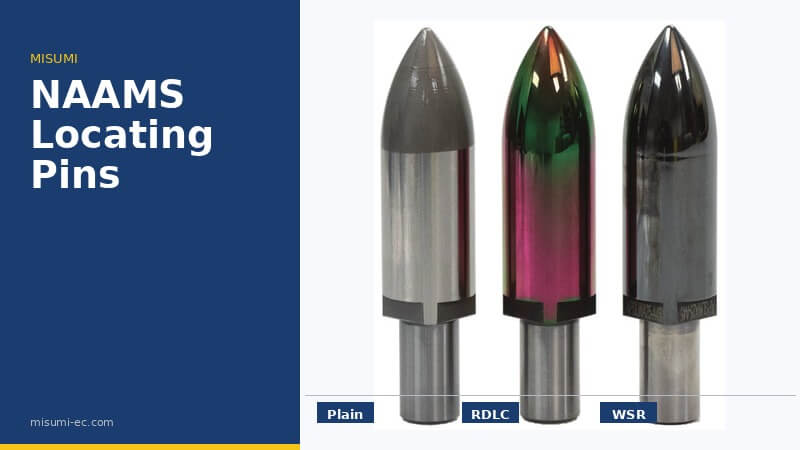
Locating pins in resistance welding environments face a problem that costs automotive manufacturers in downtime, scrap, and line stoppages: weld spatter. This guide covers how MISUMI’s WSR (Weld Spatter Resistant) NAAMS locating pins solve that problem, how they compare to ceramic-sleeved alternatives, and when to choose WSR over RDLC for your application.
What causes locating pin failure in body-in-white welding?
In Body-in-White (BIW) body shell construction, locating pins position steel panels precisely during resistance welding. Every weld cycle produces molten metal particles, aka weld spatter, that land on nearby surfaces.
Over thousands of cycles, spatter accumulates on locating pins, causing:
- Dimensional inaccuracy at the locating interface
- Increased insertion and extraction force, accelerating wear
- Pin seizure or part misalignment, leading to scrap
- Line stoppages for manual cleaning or pin replacement
The standard industry response has been ceramic-sleeved locating pins. Ceramic resists spatter adhesion effectively, but the sleeve design introduces a different failure mode: the ceramic sleeve sits over a steel core, and that bond can fracture under transverse forces, thermal cycling, or impact during operation. When a sleeve detaches mid-production, the car bodies on that line become unusable—a far more costly failure than normal wear.
What are WSR NAAMS locating pins?
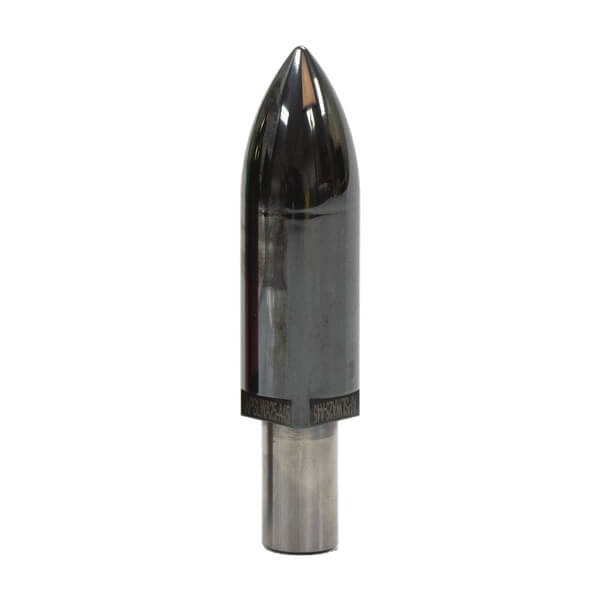
WSR NAAMS locating pins are solid D2 tool steel locating pins coated with an aluminum chromium nitride (AlCrN) surface treatment—applied by MISUMI using Physical Vapor Deposition (PVD). The coating is designated WSR: Weld Spatter Resistant.
(Need the lowdown on locating pins? Check out this article.)
Unlike ceramic-sleeved pins, WSR pins are a single-piece construction. There is no sleeve to detach, no bond to fracture, and no secondary component to manage. The AlCrN coating is deposited directly onto the steel pin in a vacuum environment, producing a hard, adherent layer with intrinsic resistance to weld spatter adhesion.
WSR pins are NAAMS-compatible and are the first steel pins demonstrated to achieve equivalent performance to ceramic-sleeved pins in BIW production environments.
How does the AlCrN WSR coating work?
AlCrN (aluminum chromium nitride) is a ceramic-class PVD coating widely used in high-performance cutting tools and wear-resistant components. Its properties in a welding environment come from three characteristics:
High hardness. At 4,000 HV, the coating surface resists the abrasive contact of steel workpieces and deflects incoming spatter particles rather than absorbing them.
Low surface energy. The coating’s chemical composition reduces the tendency of molten metal to wet and bond to the pin surface—the fundamental mechanism behind weld spatter adhesion. Spatter that lands on a WSR-coated pin is more likely to cool and detach than to fuse.
Thermal stability. AlCrN maintains its properties at elevated temperatures, which is relevant in high-cycle resistance welding where the pin surface sees repeated thermal events.
The coating is applied via PVD (Physical Vapor Deposition): the pin is placed in a vacuum chamber, and the coating material is either evaporated or sputtered onto the surface. This produces a dense, uniform layer with high adhesion to the steel substrate—not a separate bonded sleeve.
WSR coating specifications
| Property | WSR Coating | RDLC Coating | Plain Pin |
| Color | Anthracite (Deep Charcoal Gray) | Rainbow | Steel Gray |
| Hardness (HV) | 4,000 | 6,000–7,000 | ~800 (D2 steel) |
| Coating thickness (µm) | 4.0 ± 2.0 | 0.2–1.0 | — |
| Surface roughness Rz (µm) | < 1 | < 1 | Varies |
| Friction coeff. (steel, dry) | 0.15–2 | 0.15–0.2 | ~0.6–0.8 |
| Base pin material | D2 tool steel | M2 tool steel | Varies |
| Aluminum compatible? | No* | Yes | Yes |
| Weld spatter resistance | Excellent | Moderate | None |
| Recommended application | Resistance / MIG welding on steel | Steel & aluminum alignment | General use |
*WSR is not recommended for aluminum workpieces. For aluminum or Boron steel applications, see RDLC below.
Why is WSR thicker than RDLC? The 4.0 µm average WSR coating is substantially thicker than RDLC’s 0.2–1.0 µm. This is intentional: spatter resistance benefits from a physically robust surface layer, whereas RDLC’s primary function (friction reduction and galling prevention) is achieved at thinner coating depths.
WSR vs. ceramic locating pins
The critical question for BIW engineers evaluating WSR is whether it actually replaces ceramic. Our position, backed by series production data, is that WSR pins achieve at least the same results as ceramic-sleeved pins in body shell welding environments.
| Attribute | Ceramic-sleeved pin | WSR coated pin |
| Construction | Steel core + ceramic outer sleeve | Single-piece coated tool steel |
| Spatter resistance | High (ceramic surface) | High (AlCrN coating) |
| Sleeve detachment risk | Yes—fracture or delamination under load | None—no sleeve |
| Transverse force tolerance | Limited by sleeve bond strength | Full tool steel strength |
| Replaceability | Composite part; sleeve may need resleeve | Standard pin replacement |
| Price segment | Comparable | Comparable |
| Aluminum compatible | Some variants | No |
“Our WSR locating pins offer all the advantages of a plain steel pin while also having outstanding properties in terms of weld spatter resistance and wear resistance.“
—Brian Hettinger, MISUMI Product Engineer
The cost comparison is notable. WSR pins sit in the same price segment as ceramic-sleeved alternatives. Adopters gain the durability and failure-mode reliability of a monolithic steel pin without a cost premium.
Internal test results
MISUMI validated WSR pins under production-representative conditions before commercial release:
- Test location: Body Shell Construction (Body-in-White), welding area
- Test duration: 100,000 cycles
- Workpiece material: Steel
- Pin material: D2 tool steel with WSR coating
- Result: No visible wear; pin continued functioning reliably throughout the test
The 100,000-cycle figure represents substantial production volume, roughly equivalent to several months of continuous operation in a high-volume BIW line.
Series production results
WSR NAAMS locating pins have been in series production at major European automotive OEMs and their tier-one suppliers since 2018. Field data from those deployments confirms:
- Significantly extended service life versus ceramic or uncoated steel pins
- Minimal measurable wear in high-cycle welding environments
- Virtually no weld spatter adhesion over extended production runs
- Demonstrated performance across multiple OEM environments and resistance welding process types
These results have led many users to replace both ceramic-sleeved and plain steel pins with WSR variants—not only in high-spatter environments but in any application where pin wear is a recurring maintenance concern.
One USA automotive manufacturer noted that typically locating pins will need to be replaced every 2-3 weeks due to wear which causes vibration. After about 3,000 cycles of testing, the WSR coated pins showed no wear so far. They estimated that WSR locating pins will last them 2-3 times the life of the current non-coated locating pins they use.
WSR vs. RDLC: which coating is right for your application?
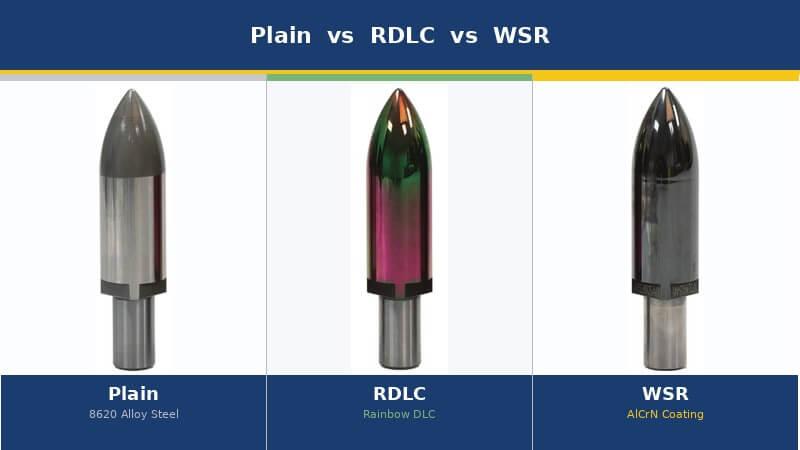
MISUMI offers two coated locating pin options. The right choice depends on workpiece material and process type:
Choose WSR when:
- Workpiece material is steel
- Process is MIG welding or resistance welding with significant spatter
- The primary failure mode is spatter accumulation or spatter-related wear
- Aluminum is not involved in the locating interface
Choose RDLC when:
- Workpiece material is aluminum, aluminum die casting, or Boron steel
- Process is a sliding or alignment application with repeated engagement cycles
- The primary failure mode is galling, cold welding, or adhesive wear
- Weld spatter is not a significant factor
RDLC (Rainbow Diamond-Like Carbon) reaches higher hardness (6,000–7,000 HV) and has lower friction variability (0.15–0.2 vs. WSR’s 0.15–2), making it better suited for precision alignment of soft or reactive metals where galling prevention matters more than spatter protection.
Neither coating is a substitute for a plain pin in applications with no welding exposure and low cycle counts. In those cases, the coating adds cost without proportionate benefit.
Shop Locating PinsFrequently asked questions
Can WSR locating pins be used with aluminum workpieces? No. WSR is not recommended for aluminum workpieces. The coating performs best in steel-on-steel contact in welding environments. For aluminum or Boron steel applications, MISUMI’s RDLC coating is the correct choice.
How is the WSR coating applied? Via PVD (Physical Vapor Deposition)—specifically evaporation or sputtering in a vacuum chamber. This produces a dense, adherent coating without the substrate heating that some alternative deposition methods require, preserving the mechanical properties of the D2 tool steel pin.
Does the WSR coating change the pin’s dimensional tolerances? The coating adds 4.0 ± 2.0 µm to the pin surface. For precision-fit NAAMS locating applications, this is accounted for in the pin dimensions. Consult MISUMI’s product specifications for the relevant fit tolerances.
How do WSR pins compare in cost to ceramic-sleeved pins? WSR pins sit in the same price segment as ceramic-sleeved alternatives. Given the extended service life demonstrated in OEM production environments, total cost of ownership is typically lower.
What is the NAAMS standard? NAAMS (North American Automotive Metric Standard) is a standards program defining common component specifications for automotive manufacturing fixtures, including locating pins. NAAMS compatibility ensures dimensional interchangeability across suppliers and tooling systems.
Can WSR pins replace existing ceramic pins without fixture modification? In most cases, yes—NAAMS-compliant WSR pins are dimensionally interchangeable with other NAAMS locating pins. Verify fit tolerances for your specific application before direct substitution.
Summary
WSR NAAMS locating pins address the core failure modes of ceramic-sleeved pins in body-in-white welding: spatter adhesion and sleeve delamination. By applying an AlCrN coating to solid D2 tool steel via PVD, MISUMI delivers a pin with intrinsic spatter resistance, full steel-pin mechanical strength, and no composite construction to fail.
For BIW process engineers managing ceramic pin breakage, spatter-related scrap, or high locating pin replacement frequency in resistance welding cells, WSR pins offer a drop-in alternative tested to 100,000 cycles and proven in European OEM series production since 2018.