
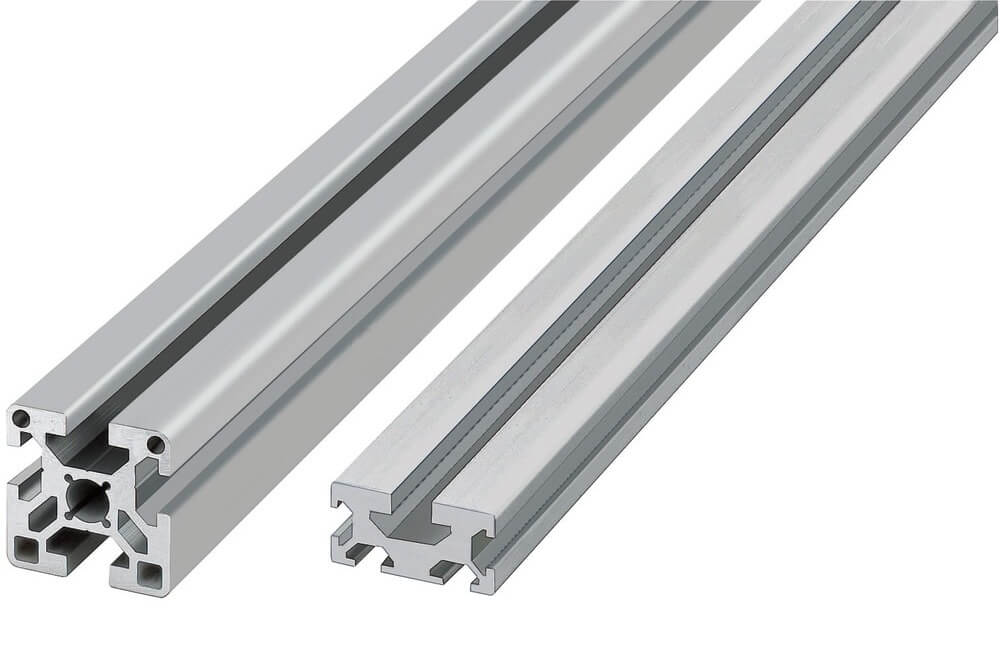
Aluminum extrusion is a manufacturing process that produces structural profiles with a consistent cross-section by forcing aluminum alloy through a shaped die. Aluminum extrusion profiles are the structural skeleton of machine builds, frames, enclosures, and equipment, either as hidden internal structure or as the outward-facing surface of the assembly—the bones around which everything else is designed.
Profile selection affects load capacity, vibration resistance, assembly complexity, shipping cost, and maintainability. The core variables are shape, material type, series, and finish.
This guide covers each one and explains how they interact with hardware selection.
What Profile Shapes Are Available in Aluminum Extrusion?
Aluminum extrusion profiles come in three categories: square, rectangular, and specialty. Most designs are built almost entirely from square and rectangular profiles, with specialty shapes added in specific spots where the geometry or finish requires it.
Square profiles
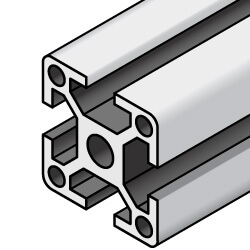
Square profiles are where most designs start. Four slots—one on each face—give you connection points in every direction, which makes them the most flexible building block for any frame or enclosure. Pick a base square size that fits your structural and aesthetic requirements, then pull in rectangular versions of the same profile family wherever you need more span or directional stiffness.
Sizes run from 15mm up to 100x100mm. The most commonly ordered square profiles are:
Rectangular Profiles
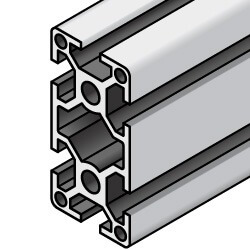
Rectangular profiles provide higher bending resistance along the long axis than a square of the same series. Use them when a horizontal member needs to carry a distributed load or span a longer distance without jumping to a heavier square profile.
Commonly ordered rectangular profiles:
Specialty Profiles
Reduced-slot profiles (1-, 2-, or 3-slot variants) are for situations where an outward-facing surface needs to look clean. If you’d rather not change the base profile, slot covers accomplish the same thing—press them into any unused channel after assembly.
Radius and quarter-round profiles put a curved surface at corners and edges. Common in safety enclosures, operator-facing panels, and anywhere a sharp extruded corner isn’t acceptable.
Bent or curved extrusion is a profile formed to a 90-degree bend with the internal slot channel kept intact all the way through the bend. That’s the hard part—a standard bend operation collapses or distorts the slot and makes it unusable for hardware. Keeping the slot continuous through a bend requires a specific forming technique and isn’t widely available. Where it is available, it lets you build cleaner corners without extra joining brackets. MISUMI is able to provide bent extrusion profiles.
Summary:
Start with square profiles, add rectangulars where you need directional stiffness, and reach for specialty profiles only when the geometry or finish requires it. Four-slot square profiles are the most versatile and most commonly ordered.
What Is the Difference Between Standard, Lightweight, and High Rigidity Aluminum Extrusion?
The three types have the same outer dimensions but different internal cross-sections—more or less material inside the profile. That difference drives stiffness, weight, and cost.
Standard is partially hollow and is the right default for most designs. It represents the industry baseline for stiffness-to-weight performance. If you don’t have a specific reason to go lighter or heavier, use standard.
Lightweight has more material removed from the interior. It’s less rigid, but lighter and less expensive. It works well for benchtops, light-duty fixtures, and members where deflection isn’t a governing concern. A lot of designers never consider it and just spec standard out of habit. It’s worth running your load case first, because on a large build the cost and weight savings from switching non-critical members to lightweight can add up quickly.
High rigidity is close to solid. High rigidity extrusion gives you the highest bending resistance and moment of inertia for the outer dimensions. Use it when vibration isolation matters, when you’re putting heavy point loads on the frame, or when you need impact or shock resistance. It costs and weighs significantly more than standard.
Summary:
Standard is the right default. Use lightweight when your load case allows it and you want to save cost or weight. Use high rigidity only when the application specifically demands it. Same outer dimensions across all three—the difference is inside.
What Is Aluminum Extrusion Series and How Does It Affect Hardware Selection?
Series sets the slot width. Since aluminum extrusion accessories like T-nuts, brackets, and fasteners have to physically seat into that slot, it has to match the series of the extrusion. Grabbing the wrong series hardware is one of the more common assembly mistakes, and it’s easy to do when part numbers look similar.
MISUMI USA currently offers 3, 5, 6, 8, and 8-45 series. A higher series number means a wider slot and a larger base profile dimension. Most designs use a single series throughout. Mixing series is possible but increases inventory complexity and the risk of assembly errors.
One exception worth knowing: 8 series and 8-45 series share the same slot geometry, so T-nuts work in both. Brackets are still series-specific—don’t swap those between 8 and 8-45.
A quick example to explain how series affects the product: MISUMI offers 40×40 extrusion in both 5 series (HFS5-4040) and 8 series (HFS8-4040):
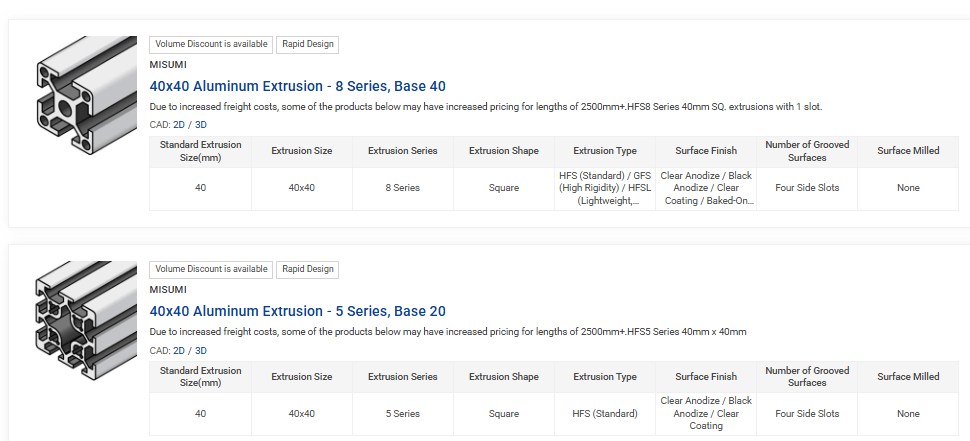
Both pieces are 40x40mm, but they have different series and bases. The 5 series is effectively a double-square base 20, while the 8 series is a single-square base 40. The 8 series has a single slot on each side for hardware and more material than the 2-slotted 5 series. This gives the 8 series a higher resistance to bending (cross-sectional moment of inertia), but also makes it heavier. It’s important to remember which series you’re using in your design. The part numbers can look very similar, but the product is very different.
To help you visualize the differences:
| HFS5-4040 | HFS8-4040 | |
| Outer dimensions | 40x40mm | 40x40mm |
| Series | 5 | 8 |
| Base | Double base-20 | Single base-40 |
| Slots per face | 2 | 1 |
| Hardware | M5 | M8 |
| Cross-section | More void space, lighter | More material, higher moment of inertia |
| Best for | Lighter structures, two-point connections per face | Higher load applications, single-point connection per face |
Ordering hardware on MISUMI? Once you’ve locked in your series, filtering by series on any hardware category page returns only components confirmed to fit that slot geometry.
Summary:
Series = slot size. Hardware must match the series or it won’t fit. Lock in series before you touch hardware selection. Most designs use one series throughout.
What Finish Options Are Available for Aluminum Extrusion?
MISUMI offers three aluminum extrusion finish options. Clear and black are anodized coatings; yellow is a powder coat. These are different surface treatment processes with different performance characteristics under wear and cleaning.
Clear anodized is the standard finish for internal or hidden structural members. It provides corrosion resistance without altering the natural aluminum appearance.
Black anodized is used for outward-facing assemblies where aesthetics are a consideration. The process provides the same corrosion protection as clear anodizing with a uniform matte black surface.
Yellow powder coat is the standard finish for safety fencing and perimeter fencing applications. The yellow color is commonly associated with safety equipment and may be required by facility or regulatory standards in those applications.
Summary:
Clear anodized for hidden structure. Black anodized for visible structure. Yellow powder coat for safety guarding. Clear and black are anodized (harder, more abrasion-resistant); yellow is powder coated.
Ordering Considerations: Cut-to-Length vs. Raw Stock
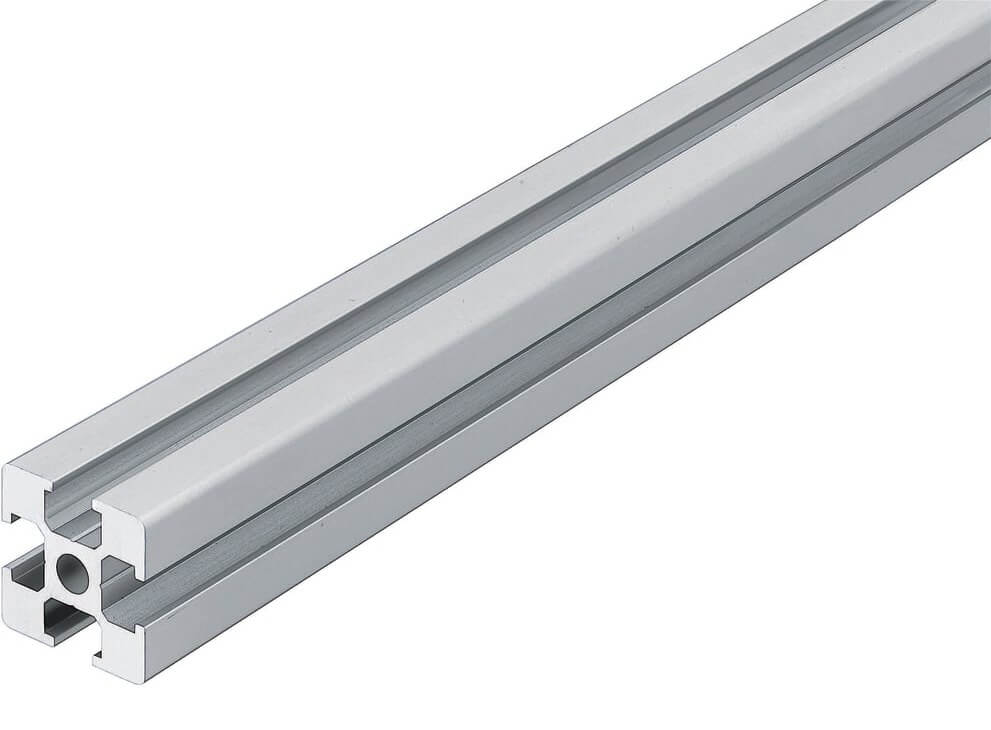
Ordering raw stock at maximum length and cutting it down in-house is a common default, but it creates avoidable costs. Ordering cut-to-length profiles—with holes, tapped ends, or other required alterations completed before shipment—means your parts arrive ready to install with no internal processing or third-party machining required.
There is also a freight implication. Full-length extrusion (up to 4 meters) must ship via LTL truck. Cut-to-size pieces that fit within standard parcel dimensions ship via ground courier, which is typically faster and cheaper. On a large order, the difference in freight cost is significant.
For complex designs with many line items or a high volume of part number alterations, MISUMI’s FRAMES design tool generates a complete bill of materials directly from the structural model, including all part number parameters needed to order each component as specified. You skip the manual process of decoding alteration tables in the catalog, and you’re less likely to build a wrong part number.
Summary:
Order cut-to-length with alterations, not raw stock. It eliminates in-house processing, reduces errors, and often changes the shipping method from LTL freight to standard parcel, which is faster and cheaper.
Aluminum Extrusion Profile Best Practices
1. Series first: Lock in series before specifying any hardware. Everything else—nuts, brackets, fasteners—must match the series of the extrusion.
2. Shape follows load: Use square profiles as the base. Add rectangular profiles where directional bending resistance is needed. Use specialty profiles only where geometry or finish requirements demand them.
3. Type follows application: Run the load case before defaulting to standard. Lightweight is often sufficient for non-critical members and reduces cost and weight meaningfully at scale. High rigidity is for specific high-load or high-vibration conditions only.
4. Finish follows visibility and application: Clear anodized for hidden structure, black anodized for visible structure, yellow powder coat for safety guarding.
5. Order cut-to-size: Cut-to-size with alterations reduces internal processing, eliminates third-party machining steps, and can change the shipping method from LTL to parcel.
Shop Extrusions & AccessoriesDesigning Aluminum Frames?
FRAMES is a free click-and-drag 3D design tool built to make aluminum extrusion easy. It automatically handles the hardware, the alterations, and your BOM to help you design frames in a fraction of the time. Here’s 4 tips on how to use FRAMES.
Download FRAMES FreeFrequently Asked Questions
What series hardware fits 40×40 aluminum extrusion? It depends on which 40×40 profile you are using. HFS8-4040 requires 8 series hardware (M8). HFS5-4040 requires 5 series hardware (M5). Always verify the series of the specific profile before selecting hardware.
Can aluminum extrusion be bent without losing the slot? Yes, but it requires a specific forming technique to maintain the internal slot geometry through the bend. A standard bending operation collapses the slot. Bent extrusion with a continuous slot is available but not common across all suppliers.
What is the difference between anodized and powder coated aluminum extrusion? Anodizing is an electrochemical process that converts the surface layer of the aluminum itself into aluminum oxide. Powder coating is a separate coating applied to the surface via electrostatic deposition and cured under heat. Anodized finishes (clear and black) are harder and more abrasion-resistant; powder coat (yellow) provides a thicker, colored surface layer.
When should you use lightweight aluminum extrusion instead of standard? Use lightweight when the structural analysis confirms the member is not a load-critical element—benchtops, light enclosures, non-structural panels, and similar applications. If deflection, vibration, or impact resistance are governing requirements, use standard or high rigidity.
What does the series number mean in aluminum extrusion? The series number corresponds to the slot width in the profile. A higher series number means a wider slot and a larger base profile dimension. Series also determines which hardware is compatible—T-nuts, brackets, and fasteners are all series-specific.